I'm not going to share all my New Year's resolutions with you, but one thing I really want to do is a 2015 reading list I found on Pinterest.
I had already made a goal to read a book a week (which isn't hard for me to do, but sometimes I just don't), but this list is going to make me branch out a bit on my reading choices.
Here's the list, and the books I've chosen for each category. I'm going to try and only read books I've never read before, I won't use the same book for multiple categories, and you can be sure I'll review each one.
A book with more than 500 pages: Anna Karenina by Leo Tolstoy
A classic romance: Gone with the Wind by Margaret Mitchell
A book that became a movie: The Zookeeper's Wife by Diane Ackerman
A book published this year (I'm gonna do 2014): Leaving Time by Jodi Picoult
A book with a number in the title: A Thousand Splendid Suns by Khaled Hosseini
A book written by someone under 30: Half of a Yellow Sun by Chimamanda Ngozi Adichie
A book with nonhuman characters: Watership Down by Richard Adams
A funny book: The Pickwick Papers by Charles Dickens
A book by a female author: Cinder by Marissa Meyer
A mystery or thriller: And Then There Were None by Agatha Christie
A book with a one-word title: Emma by Jane Austen
A book of short stories: Smoke and Mirrors by Neil Gaiman
A book set in a different country: The Rent Collector by Camron Wright
A nonfiction book: Endurance: Shackleton's Incredible Voyage by Alfred Lansing
A popular author's first book: Elantris by Brandon Sanderson
A book from an author you love that you haven't read yet: The Blood of Olympus by Rick Riordan
A book a friend recommended: Anna and the French Kiss by Stephanie Perkins
A Pulitzer Prize-winning book: The Color Purple by Alice Walker
A book based on a true story: The Undaunted by Gerald Lund
A book at the bottom of your to-read list: On Basilisk Station by David Weber
A book your mom loves: Shannon Derry by Carol Warburton
A book that scares you: The 5th Wave by Rick Yancey
A book more than 100 years old: The Canterbury Tales by Geoffrey Chaucer
A book based entirely on its cover: The Thirteenth Tale by Diane Setterfield
A book you were supposed to read in school but didn't: Catcher in the Rye by J.D. Salinger
A memoir: Diary of a Young Girl by Anne Frank
A book you can finish in a day: The Body in the Library by Agatha Christie
A book with antonyms in the title: War and Peace by Leo Tolstoy
A book set somewhere you've always wanted to visit: Dogsong by Gary Paulsen
A book that came out the year you were born: Number the Stars by Lois Lowry
A book with bad reviews: The Nanny Diaries by Emma McLaughlin
A trilogy: The Hourglass Door trilogy by Lisa Mangum
A book from your childhood: Little Women by Louisa May Alcott
A book with a love triangle: The Hero and the Crown by Robin McKinley
A book set in the future: Legend by Marie Lu
A book set in high school: I Am Not a Serial Killer by Dan Wells
A book with a color in the title: Strands of Bronze and Gold by Jane Nickerson
A book that made you cry: My Sister's Keeper by Jodi Picoult
A book with magic: Wizard of Earthsea by Ursula K. Le Guin
A graphic novel: Watchmen by Alan Moore
A book by an author you've never read before: The Captive Maiden by Melanie Dickerson
A book you own but have never read: The Story of Edgar Sawtelle by David Wroblewski
A book that takes place in your hometown: Letters for Emily by Camron Wright
A book that was originally written in a different language: The Hunchback of Notre Dame by Victor Hugo
A book set during Christmas: The Mistletoe Promise by Richard Paul Evans
A book written by an author with your same initials: The Collected Works of C. S. Lewis
A play: Hamlet by William Shakespeare
A banned book: Of Mice and Men by John Steinbeck
A book based on or turned into a TV show: North and South by Elizabeth Gaskell
A book you started but never finished: The Count of Monte Cristo by Alexandre Dumas
These are all subject to change, and I probably won't read them in that order, but this is my list! Wish me luck getting through them all in one year.
Friday, January 2, 2015

Tuesday, December 30, 2014
Movie/Book Review: Unbroken by Laura Hillenbrand
 |
| Cover of the biography property of Random House Publishing Group. |
Wow, it's been a long time since I wrote last. Sorry about that. Hope you all had a Merry Christmas! I sure did.
During the holiday season there were a lot of topics that I half-heartedly wanted to write about, but none of them drove me to write. This morning I feel driven. It's like an annoying itch that will only go away once I put the words down.
Last night my family and I went to see "Unbroken." Not all of us were very excited to see it, because half of us had read the book, and the reviews were very mixed. Some of us had been wanting to see "Big Hero 6" or "Into the Woods" because their reviews were very very positive. But last night we just really wanted to see ANY movie, and we were all curious enough about "Unbroken" to agree on it and give it a shot.
Maybe it was just my low expectations, but I was very pleasantly surprised by how well-made it was. I assumed the bad reviews were because of bad acting or bad production or something, but I was so wrong. The acting was great, the production value was incredible, and I thought it was very true to the story. It was a longer movie than I expected, and it did a good job of taking the time to show Louis Zamperini surviving his trials during the war.
I recommend it to everyone, though be prepared for some gritty details they kept in. There were a couple things that made my stomach churn. It could have been worse, though. A blow-by-blow adaptation of the book would have been rated R.
So I was pleasantly surprised by how good it was. However, I can see why some reviewers didn't like it, and I do have a foot in their camp.
The ending was such a disappointment. Beware of spoilers if you haven't read the book.
The movie does a brilliant job of showing Louis' war days, from when he's a bombardier to when he survives on the ocean to when he survives the POW camps. And it shows him becoming a great runner and going to the Olympics and all that. All those incidents are, of course, amazing. Louis Zamperini was an incredible person, and what he went through is almost unbelievable.
However, the movie ends when Louis comes home from war. To the average viewer who hadn't read the book, that would seem like an appropriate happy ending for a war-torn hero. But if you have read the book, then you know that coming home from the war was not his ultimate triumph! In fact, Louis was a mess when he came back from war. He had severe post-traumatic stress to the point that he was always yelling at his family, became withdrawn from society, almost ruined his marriage, and sunk into alcoholism for a long time. Yes he was strong and defiant and brave during all this war trials, but when he went home, he actually was pretty broken. So for me, who had read the book, having it end there just made me sad. It didn't give me a triumphant feeling at all.
The triumph of Louis's life was not that he got through the war. It was that he got through the consequences of the war, rose about the alcoholism and the anger and the depression, and actually turned his life over to God. He found peace in his heart through the Atonement, and he learned to forgive the captors who had ruined his life.
The book is one of the most incredible reads of my life. Laura Hillenbrand wrote the most detailed and interesting biography I've ever read, and she made sure that there was that overall theme of Louis rising above challenges and finding God in his life.
Angelina Jolie got the overcoming challenges part down okay, and her directional debut was much better than I expected. But her theme of Louis finding God and learning to forgive was glossed over in a text-on-screen epilogue, like P.S. Louis really did turn to God, but you don't get to see it. Oh and P.P.S. he also met with and forgave his captors, but you don't get to see that either.
Those were the parts I really wanted to see because they were what stunned me the most when I read the book. To have them just tacked onto the end was like a slap in the face.
I wish she had gone either direction--either making it a half hour longer to show us Louis' post-war problems and unbroken attitude in the end (yes, I would have happily sat through despite the fact that it was already a very long movie); or just cutting out the mentions of Louis dedicating his life to God. Obviously I wouldn't have liked it that way, either, but at least it wouldn't have felt so thrown together. Just saying in the end that he became faithful and positive almost confuses the audience, because there was nothing during his war years that showed him turning to God (except for that one time when he thought he was going to die on the ocean, but never again after that).
In conclusion, I really did like this movie. It was an amazing watch, and I recommend it to everybody who's seen the mixed reviews and isn't sure about it. Kudos to Angelina Jolie for doing as well as she did. I look forward to seeing what she'll do next. I just hope that next time she doesn't use a cop-out ending like this one.
However, I recommend reading the book first so that you can really get a feel for who Louis Zamperini was and what his unbroken spirit was really about.
Sunday, December 7, 2014
Sunday Soliloquy: We Need a Little Christmas

During our morning scripture study, Sarah and I were talking about fasting and why we need to do it at least once a month. After reading several verses and talking about personal experiences, we concluded that fasting is a kind of magnified, extended prayer.
Prayer is something we do (or should do) every morning and every evening, and really any time. But when we fast, we humble ourselves a little more. Every rumble of our empty bellies is like a reminder to pray and think about why you're fasting and what you're asking of the Lord. Rather than pray in the morning and then forget to pray again until evening, our hunger reminds us all day to have a prayer in our hearts.
Christmas is like fasting.
You know the song, "We Need a Little Christmas"? I used to find it so annoying, but now it's one of my favorites.
Here are the lyrics, in case you're unfamiliar with it:
Haul out the holly;
Put up the tree before my spirit falls again.
Fill up the stocking,
I may be rushing things, but deck the halls again now.
For we need a little Christmas
Right this very minute.
Candles in the window,
Carols at the spinet.
Yes we need a little Christmas
Right this very minute.
It hasn't snowed a single flurry,
But Santa, dear, we're in a hurry.
So climb down the chimney;
Put up the brightest string of lights I've ever seen.
Slice up the fruitcake;
It's time we hung some tinsel on that evergreen bough.
For I've grown a little leaner,It's a very cheerful melody. Very peppy. Which is why I never really liked it before--I tend to gravitate towards the somber, reverent Christmas songs.
Grown a little colder,
Grown a little sadder,
Grown a little older.
And I need a little angel
Sitting on my shoulder;
Need a little Christmas now!
But that last verse is as somber as they come even if the tune is upbeat, and it kind of encompasses everything I feel around the Christmas season.
This week in Utah has been really sunny, but usually it's incredibly cold, cloudy, and miserable this time of year. Even though we now know Christ was born in April, I'm kind of glad Christmas is in December, because what better time for the most cheerful holiday of the year?
By December, we're looking back on the goals we didn't meet, the funds we failed to save up, the improvements we neglected this year. We're freezing and the days are short, which means less natural endorphins from sunlight. And the older we get, the less magical the world around us seems to be.
But then--Christmas! Christmas happens! And who cares that we fell short? Who cares that it's dark and cold and miserable? It's Christmas!
We need Christmas to come around every year. It's not just a nice tradition; it's something as necessary for our yearly spiritual health as a fast is for our monthly spiritual health. We need it.
Christmas means making an effort to connect with people. It means giving gifts to neighbors we've never met and to coworkers we don't get along with and to family members we may be disconnected from.
It means that even when we've grown too old to believe in Santa Claus and flying reindeer, we can still think back on the magic and the wonder we used to feel. It means that we strive to feel it again, or at least help those around us feel it again or for the first time.
But most of all, Christmas means thinking about the Savior. Just as fasting is an extra push of prayer (which should be a daily habit), thinking of Christ should be something we do every day of the year, but the month of December gives us reminders at every turn. It's in our face wherever we go--in supermarkets and on the radio and in our homes.
Christmas gives us that extra nudge to remember the greatest gift that God has ever given us--His beloved son, Jesus Christ.
One of my favorite parts of the Book of Mormon is when Nephi is asking the angel about his father's vision of the Tree of Life. The angel shows Nephi the tree, and Nephi asks for an interpretation.
The angel could have very easily just said, "Oh, it's God's love." Instead, the angel disappeared, and Nephi had a vision of his own.
And it came to pass that I looked and beheld the great city of Jerusalem, and also other cities. And I beheld the city of Nazareth; and in the city of Nazareth I beheld a virgin, and she was exceedingly fair and white.
And it came to pass that I saw the heavens open; and an angel came down and stood before me; and he said unto me: Nephi, what beholdest thou?
And I said unto him: A virgin, most beautiful and fair above all other virgins.
And he said unto me: Knowest thou the condescension of God?
And I said unto him: I know that he loveth his children; nevertheless, I do not know the meaning of all things.
And he said unto me: Behold, the virgin whom thou seest is the mother of the Song of God, after the manner of the flesh.
And it came to pass that I beheld that she was carried away in the Spirit; and after she had been carried away in the Spirit for the space of a time the angel spake unto me, saying: Look!
And I looked and beheld the virgin again, bearing a child in her arms.
And the angel said unto me: Behold the Lamb of God, yea, even the Son of the Eternal Father! Knowest thou the meaning of the tree which thy father saw?
And I answered him, saying: Yea, it is the love of God, which sheddeth itself abroad in the hearts of the children of men; wherefore, it is the most desirable above all things.
And he spake unto me, saying: Yea, and the most joyous to the soul.
(1 Nephi 11: 13-23)
Nephi already knew that the Lord loves all His children. That was probably the most fundamental thing Nephi knew--the thing his "goodly parents" taught him his whole life.
But then he saw the first Christmas, and he knew.
God loves us. He didn't send His Beloved Son to be born of a virgin in a lowly manger just to show us a miracle--He did it so that His Son could grow up leading us by example, work miracles to give us hope and comfort, suffer for our sins, and conquer death. All for our sakes.
God has given us countless blessings--so many that we probably don't even know about, let alone acknowledge. But His Son was the greatest gift of all--the light of the world.
It's something we should remember every day of our lives, but Christmas gives us that extra little push--that constant reminder in the month of December that lifts our spirits and reminds us of the love God has for us all year round.
So rather than get annoyed by people who clamor for "A little Christmas now," I'm going to try to appreciate every day of this month where everyone and everything around me reminds me of what I wish I remembered more during the rest of the year.May we all feel God's love for us and for those around us as we celebrate this wonderful Christmas season.
God bless us, every one.
Saturday, December 6, 2014
Ambiance/Production(?) Review: The Forgotten Carols by Michael McLean
You may or may not know this already, but I've been hired as the Deseret Book corporate office receptionist, which I'm extremely excited about because I get to meet cool people ever day, it's deep in the heart of the editing world, and I get awesome perks.


Case in point: By the time I started working there, Secret Santa assignments had already been given and carried out and I didn't expect to be involved in any way. But on my second day, I got to my desk and found these from Santa!
Awww! Unfortunately I'm off of sugar right now (which will get its own blog post explanation later), so I didn't eat them myself but Mom, Sarah, and Ashley really enjoyed them! And in this case, it really was the thought that counted.
I could list a bunch of awesome people (including some LDS celebrities) that I met just this first week in the office, but I won't. Just know it's been incredible.
And then on Thursday it was a normal, chill day at the desk when I got an e-mail saying that Corporate was giving away 100 free tickets to their employees for The Forgotten Carols Friday night in Orem.
I pounced. Not even knowing who could go with me or if I could make it, I snatched up four tickets right away.
The Forgotten Carols has been a part of my life for as long as I can remember. I grew up listening to the CD while driving home from grandparents' houses on cold winter nights. I read the book once a long time ago. But I had yet to actually see the full production. It's been on my bucket list for forever, I just never got the chance or had the money.
So to be offered tickets for free (even if they were last-minute for a production far away) was the best Christmas present I could have asked for this season.
 |
| Official logo from forgottencarols.com |
I'm categorizing this as partly Ambiance because going to this production was an experience. It wasn't a play to be analyzed and criticized, it was a memory and a flood of feelings that has to be witnessed for oneself to be understood--as grandiose and moving as a spectacular landscape or a brilliant sunrise.
I was really stressed leading up to the performance, because I was told we had to claim my tickets before 6:30 or they would be given away. Cue bumper-to-bumper traffic.
We made it there by 6:45, and to my immense relief my tickets were still there waiting for us! It was just me and Mom who made it (it was too last minute for anyone else to come with us), and we had great seats only a few rows back from the side of the stage.
I knew what to expect from the story because, like I said, I grew up listening to it and reading it. But seeing it all in musical form was completely different. The singing wasn't as good as the CD I have on my iPod, but the acting was good and hearing the songs in the context was like really hearing them for the first time.
For those of you who know absolutely nothing about The Forgotten Carols, it's about a nurse named Constance who is given the task of taking care of an eccentric old man over the week of Christmas. Constance is always caught up in her work and doesn't connect with people well. When she arrives at the man's house, she is at first very annoyed by the crazy "Uncle" John, who resists her professionalism, calling her Connie Lou, insisting he's over 2000 years old, and sharing Christmas carols with her that she's never heard before.
 |
| Photo from forgottencarols.com |
Uncle John's carols are all from people who witnessed the birth of the Savior themselves (he's 2000 years old, remember, so he knew them all personally), and as he shares them, Constance's empty life is gradually filled with the true spirit of Christmas, and she learns to open her heart to others.
Here's a trailer, if that wasn't enough for you:
It's a very simple stage production, with a limited cast and a small choir, but the music and the feelings were as powerful as a MoTab performance in the Conference Center.
I laughed, and I cried. Oh my goodness did I cry. The touching story of Uncle John forever changing Connie Lou's life wasn't the half of it, though that was tear-jerking on its own. No, what really got to me was how Michael McLean ended the show.
I laughed, and I cried. Oh my goodness did I cry. The touching story of Uncle John forever changing Connie Lou's life wasn't the half of it, though that was tear-jerking on its own. No, what really got to me was how Michael McLean ended the show.
McLean plays Uncle John himself, so when he came onto the stage to end the show, we all greeted him with roaring applause. But after a few more jokes and thanks to those who helped put it together, he got very sober. He told us how this was his first production without at least one of his parents in attendance, and that he was actually wearing his late father's clothes as Uncle John's costume.
He then proceeded to play one of his older songs for us on the piano. I'm sure you'd recognize it if you heard it. The chorus goes, "We can be together forever someday," repeated three times. Hearing him sing it was sad enough, knowing he was thinking of his parents. But then he played it again and had us sing the chorus with him.
Afterwards, he said, "Wow. That was...so reverent." We'd all kind of mumble-sung it half-heartedly, so he made us sing it again, this time with our arms linked with the people sitting next to us. This time we all sang a little louder--with a little more love in our hearts.
Finally, he told us to think about someone who wasn't there with us--someone who just couldn't make it. Someone who is far away. Someone who maybe isn't even on this side of the veil anymore.
When we sang it that last time, half of the audience sang it at the top of their lungs. The rest of us were too choked up with tears to sing at all.
McLean let the chorus trail off. The dark auditorium was filled with eye drying and sniffles. He asked us to remember what the Christmas season is really about. He reminded us that we sometimes feel like our carols are forgotten, but that Christ and Heavenly Father never forget us. And then he asked us to sing the one carol we'll never forget--"Silent Night."
Again, I was too choked up to sing very much, but I did my best. After singing the first verse, he asked us to hum it again. As we did, he said goodbye, he walked off the stage, and the lights shut off before we'd even made it to the last line.
A few people clapped when the song faded away, but for the most part the audience was quiet. Reverent. I've never seen anything like it before. Not even General Conference ends that quietly and thoughtfully.
I left that auditorium with a resolve in my heart to not only listen to The Forgotten Carols until April but also to open my heart more and remember Christ. Not just during the month of December, but all year round.
In summary, I recommend seeing this production if you get the chance. I HIGHLY recommend it. No matter who you are, no matter your circumstance, this production will speak to you. It will remind you what Christmas is all about. Who it has always been about.
Merry Christmas!
He then proceeded to play one of his older songs for us on the piano. I'm sure you'd recognize it if you heard it. The chorus goes, "We can be together forever someday," repeated three times. Hearing him sing it was sad enough, knowing he was thinking of his parents. But then he played it again and had us sing the chorus with him.
Afterwards, he said, "Wow. That was...so reverent." We'd all kind of mumble-sung it half-heartedly, so he made us sing it again, this time with our arms linked with the people sitting next to us. This time we all sang a little louder--with a little more love in our hearts.
Finally, he told us to think about someone who wasn't there with us--someone who just couldn't make it. Someone who is far away. Someone who maybe isn't even on this side of the veil anymore.
When we sang it that last time, half of the audience sang it at the top of their lungs. The rest of us were too choked up with tears to sing at all.
McLean let the chorus trail off. The dark auditorium was filled with eye drying and sniffles. He asked us to remember what the Christmas season is really about. He reminded us that we sometimes feel like our carols are forgotten, but that Christ and Heavenly Father never forget us. And then he asked us to sing the one carol we'll never forget--"Silent Night."
Again, I was too choked up to sing very much, but I did my best. After singing the first verse, he asked us to hum it again. As we did, he said goodbye, he walked off the stage, and the lights shut off before we'd even made it to the last line.
A few people clapped when the song faded away, but for the most part the audience was quiet. Reverent. I've never seen anything like it before. Not even General Conference ends that quietly and thoughtfully.
I left that auditorium with a resolve in my heart to not only listen to The Forgotten Carols until April but also to open my heart more and remember Christ. Not just during the month of December, but all year round.
In summary, I recommend seeing this production if you get the chance. I HIGHLY recommend it. No matter who you are, no matter your circumstance, this production will speak to you. It will remind you what Christmas is all about. Who it has always been about.
Merry Christmas!

Friday, November 21, 2014
Book Review: Jane Eyre by Charlotte Bronte
Everyone should go see the downtown Deseret Book window display. It's amazing. Just so you know.
I was killing time in DB this afternoon, sitting back by the bargain books. There was a copy of Jane Eyre, so I picked it up and started reading.
It's been a long time since I've read Jane Eyre. I read it my junior year of high school. Back then, I remember it being wordy and archaic-sounding, yet so enjoyable that I actually read it because I wanted to, not because I had to as homework.
Since then I've seen so many movie adaptations of Jane Eyre. They all vary in quality and entertainment ability, but I still leave each one thinking, "Man that's a great story."
When I picked it up today though, I skipped to my favorite part when Jane runs into Mr. Rochester for the first time.
I expected to enjoy the story but I was completely surprised to find how much I loved the writing. Far from being archaic, it was just beautiful and elegant and so compelling that even when paragraphs are long I still read every word and don't feel bogged down.
There's a good reason this book has stood the test of time. Not only is it a great study of human nature, questionable morals, and true love, it's just well written. It's like reading poetry. And I normally don't like reading poetry.
For those of you who haven't read it, Jane Eyre is the story of an orphan girl who has a really rough childhood, first living with her merciless cousins, and then under the thumb of a ruthless schoolmaster. But she rises above it all, staying grounded, realistic, and humble, but also positive, cheerful, honest, and kind. Her fortune changes when her boarding school changes hands and she becomes a teacher. Later she wants a change of scenery, so she decides to become a governess for a French girl in an isolated country estate. The master of the estate is almost never home, so for a while it's just her bonding with the girl.
Then one day she's out walking and runs into a stranger and helps him when his horse slips on the ice. She later discovers this is her boss, Mr. Rochester. For the next several months, they have a respectful but pretty platonic relationship. He treats her like the governess, she treats him like her boss. But then strange things start happening in the house. At one point, Jane finds Mr. Rochester's room inexplicably on fire and saves his life. While Mr. Rochester entertains guests and maintains an air of nonchalance, he and Jane develop a friendship, that then develops into something more. After a long time of will-they/won't-they, Mr. Rochester confesses his love, and Jane accepts his proposal for marriage.
Then...things get sad. Spoilers if you haven't read it before. Turns out all the spooky stuff happening in the house was caused by Mr. Rochester's insane wife. Yeah, he was married the whole time. Hence all the brooding. He tries to get married to Jane anyways, but at the ceremony it's revealed that he's still married. Jane is devastated and leaves Thornfield. She has a really hard time of it, with no friends or family anywhere, but she refuses to go back. In the end, though, she finds friends/family, employment, and fortune. In a much better position, she goes back to Thornfield to find that it has been burned down. Mrs. Rochester set the place on fire, killing herself and leaving Mr. Rochester blind and maimed. But Jane loves him anyways and, now that they are free to be married, she does so. And Mr. Rochester regains his vision around the same time Jane gives birth to their first child.
Hooray! Happy ending!
Okay so what do I like about this story? Several things.
One, the main characters are not outlandishly attractive. Mr. Rochester is described as severe-looking, athletic but not handsome, and brooding but sincere at the same time. In face, Jane feels comfortable around Rochester because he's not handsome or charming. She wouldn't know how to behave around someone treating her like a lady, so when he's always casual and short with her, she feels free to be at ease and blunt with him.
And throughout the book, Jane is described as impish, disagreeable, and sneaky-looking. She's well below Mr. Rochester's station, so she wears plain Quaker garb and never flirts. Nothing should draw Mr. Rochester to her. And yet he is drawn to her, and she to him.
In this day and age, it seems like every love interest's character can be described in three words. "HE'S SO HOT!!1!!" *Cough* Edward Cullen *Cough* It's great to see how two characters come together because they are each good people--not because they're lusting after each other, but because they establish mutual trust as the story goes on, and they get to know each other as people.
The movies aren't as good about making the main characters unattractive.
(Photos are from GettyImages.)
Two, Jane demonstrates great faith and moral fortitude. Unfortunately, the movies tend to gloss over this. They stay true to the book in that Jane leaves after everyone finds out about the crazy wife, but they always make it seem like, "Oh I can't stay--you LIED to me! I love you but I'm angry so I'm leaving!" In the book, Jane leaves because she doesn't want to give up her standards by becoming Mr. Rochester's mistress. She loves him too much to stay around and NOT be with him, so she essentially says, "Get thee hence, Satan," and avoids the temptation at all costs.

It hurts her, no doubt. She's heartbroken and homeless and even eats pig food for a while to survive, but then the blessings come raining down on her. She finds great friends (who turn out to be cousins). She comes into a fortune. And then, she receives a prompting that she should return to Thornfield, where she finds that the crazy wife has died and she's free to marry a broken but enduring Mr. Rochester.
Jane Eyre is an amazing role model, not because she throws all propriety aside and learns to be just as tough as the guys (which seems to be the rule for today's female role models). She's amazing because she demonstrates self-discipline, faith, and fortitude. She does what she knows to be right no matter how hard it is.
I think the world needs more women like Jane Eyre. And like Charlotte Bronte, I guess, since she's the one who created her. Just read these quotes:
Three, even though the story seems to go into excruciating detail and cover way more ground than it needs to, in the end you realize that it all serves a purpose. It starts with Jane living with her horrible cousins, but then it seems like she's left them and will never hear from them again, only for her to visit near the end of the book and forgive her aunt for everything she put Jane through. The details of her time at the boarding school show how Jane developed faith in God, which she desperately needed when the Big Reveal occurred. It all wraps together so well, that to skip over the excruciating details would be to cheat the reader of important and breathtaking information.
Again, the movies tend to pass over these details. Anything that was released in theaters leaves me feeling cheated, like I'm watching an underdeveloped, fake Jane on the screen. My personal favorite version is the 1983 version made by the BBC. It's super long (six hours, in fact) and the quality is dated, but it's almost word-for-word true to the book, so if you don't want to spend a week reading the book, spend six hours watching this movie.

In short, I love Jane Eyre. If you want to feel cultured but also want to be entertained and inspired, pick it up. There's a good reason why it's been considered a classic for so long, and I know it'll withstand the test of time and be a favorite for generations to come.
 |
| Book cover property of Sterling Publishing (this is the one we had in DB) |
It's been a long time since I've read Jane Eyre. I read it my junior year of high school. Back then, I remember it being wordy and archaic-sounding, yet so enjoyable that I actually read it because I wanted to, not because I had to as homework.
Since then I've seen so many movie adaptations of Jane Eyre. They all vary in quality and entertainment ability, but I still leave each one thinking, "Man that's a great story."
When I picked it up today though, I skipped to my favorite part when Jane runs into Mr. Rochester for the first time.
 |
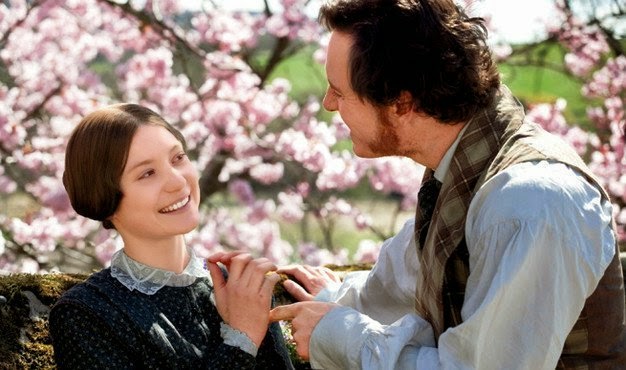
| This part. :) Photo is from the 2011 version by Focus Films. |
There's a good reason this book has stood the test of time. Not only is it a great study of human nature, questionable morals, and true love, it's just well written. It's like reading poetry. And I normally don't like reading poetry.
For those of you who haven't read it, Jane Eyre is the story of an orphan girl who has a really rough childhood, first living with her merciless cousins, and then under the thumb of a ruthless schoolmaster. But she rises above it all, staying grounded, realistic, and humble, but also positive, cheerful, honest, and kind. Her fortune changes when her boarding school changes hands and she becomes a teacher. Later she wants a change of scenery, so she decides to become a governess for a French girl in an isolated country estate. The master of the estate is almost never home, so for a while it's just her bonding with the girl.
 |
| Also from the 2011 version. |
 |
| And it's always adorable, no matter which version you watch. The book does it best, though, of course. |
 |
| I think I'm just gonna use the 2011 version for all my photos today. |
Okay so what do I like about this story? Several things.
One, the main characters are not outlandishly attractive. Mr. Rochester is described as severe-looking, athletic but not handsome, and brooding but sincere at the same time. In face, Jane feels comfortable around Rochester because he's not handsome or charming. She wouldn't know how to behave around someone treating her like a lady, so when he's always casual and short with her, she feels free to be at ease and blunt with him.
And throughout the book, Jane is described as impish, disagreeable, and sneaky-looking. She's well below Mr. Rochester's station, so she wears plain Quaker garb and never flirts. Nothing should draw Mr. Rochester to her. And yet he is drawn to her, and she to him.
In this day and age, it seems like every love interest's character can be described in three words. "HE'S SO HOT!!1!!" *Cough* Edward Cullen *Cough* It's great to see how two characters come together because they are each good people--not because they're lusting after each other, but because they establish mutual trust as the story goes on, and they get to know each other as people.
The movies aren't as good about making the main characters unattractive.
 |
| Oh yeah that Michael Fassbender isn't attractive AT ALL. *cough* No WAY do I find him good looking. Whew! Did someone turn off the air conditioner or what? |
 |
| And that Mia Wasikowska! So mousy! So plain! So not gorgeous! |
Two, Jane demonstrates great faith and moral fortitude. Unfortunately, the movies tend to gloss over this. They stay true to the book in that Jane leaves after everyone finds out about the crazy wife, but they always make it seem like, "Oh I can't stay--you LIED to me! I love you but I'm angry so I'm leaving!" In the book, Jane leaves because she doesn't want to give up her standards by becoming Mr. Rochester's mistress. She loves him too much to stay around and NOT be with him, so she essentially says, "Get thee hence, Satan," and avoids the temptation at all costs.
It hurts her, no doubt. She's heartbroken and homeless and even eats pig food for a while to survive, but then the blessings come raining down on her. She finds great friends (who turn out to be cousins). She comes into a fortune. And then, she receives a prompting that she should return to Thornfield, where she finds that the crazy wife has died and she's free to marry a broken but enduring Mr. Rochester.
Jane Eyre is an amazing role model, not because she throws all propriety aside and learns to be just as tough as the guys (which seems to be the rule for today's female role models). She's amazing because she demonstrates self-discipline, faith, and fortitude. She does what she knows to be right no matter how hard it is.
I think the world needs more women like Jane Eyre. And like Charlotte Bronte, I guess, since she's the one who created her. Just read these quotes:
 |
| This is apparently Charlotte Bronte. Courtesy of The Telegraph. |
(After Mr. Rochester argues that they should just live together unmarried because no one will care) “I care for myself. The more solitary, the more friendless, the more unsustained I am, the more I will respect myself.”
"I am no bird; and no net ensnares me; I am a free human being, with an independent will; which I now exert to leave you.”
“If all the world hated you and believed you wicked, while your own conscience approved of you and absolved you from guilt, you would not be without friends.”
“I can live alone, if self-respect, and circumstances require me so to do. I need not sell my soul to buy bliss. I have an inward treasure born with me, which can keep me alive if all extraneous delights should be withheld, or offered only at a price I cannot afford to give.”
(My favorite on morality) “Laws and principles are not for the times when there is no temptation: they are for such moments as this, when body and soul rise in mutiny against their rigour ... If at my convenience I might break them, what would be their worth?”
(On forgiveness) “Life appears to me too short to be spent in nursing animosity or registering wrongs.”
(On getting a good education) “Prejudices, it is well known, are most difficult to eradicate from the heart whose soil has never been loosened or fertilised by education: they grow there, firm as weeds among stones.”
(On friendship) “There is no happiness like that of being loved by your fellow creatures, and feeling that your presence is an addition to their comfort.”Okay, I'm done. Sorry, that was a lot, but there really is a lot of greatness to be found in this book.
Three, even though the story seems to go into excruciating detail and cover way more ground than it needs to, in the end you realize that it all serves a purpose. It starts with Jane living with her horrible cousins, but then it seems like she's left them and will never hear from them again, only for her to visit near the end of the book and forgive her aunt for everything she put Jane through. The details of her time at the boarding school show how Jane developed faith in God, which she desperately needed when the Big Reveal occurred. It all wraps together so well, that to skip over the excruciating details would be to cheat the reader of important and breathtaking information.
Again, the movies tend to pass over these details. Anything that was released in theaters leaves me feeling cheated, like I'm watching an underdeveloped, fake Jane on the screen. My personal favorite version is the 1983 version made by the BBC. It's super long (six hours, in fact) and the quality is dated, but it's almost word-for-word true to the book, so if you don't want to spend a week reading the book, spend six hours watching this movie.
In short, I love Jane Eyre. If you want to feel cultured but also want to be entertained and inspired, pick it up. There's a good reason why it's been considered a classic for so long, and I know it'll withstand the test of time and be a favorite for generations to come.

Tuesday, November 11, 2014
Doodle in the Margins: And the leopard shall lie down with the kid
Pairing Two: the leopard and the kid

Okay, I love leopards, but they are the devil to draw. So. Many. Spots. And this one was on its back! Try drawing a leopard's full body with all the spots in the right places and at the right sizes. It's a huge pain.
Goats are relatively easy to draw, I guess, but I don't think I've ever drawn a goat before today. It felt foreign. Goats and sheep are really weird looking, when you pay attention to them. Kind of like feet.
But this was pretty fun to draw. The wolf and lamb are just "dwelling" together, so they were more hanging out. I wanted to give the leopard and the kid an even greater sense of ease, like they just had a full day playing together and now they're relaxing as pals. I'll let you decide if I succeeded.

Okay, I love leopards, but they are the devil to draw. So. Many. Spots. And this one was on its back! Try drawing a leopard's full body with all the spots in the right places and at the right sizes. It's a huge pain.
Goats are relatively easy to draw, I guess, but I don't think I've ever drawn a goat before today. It felt foreign. Goats and sheep are really weird looking, when you pay attention to them. Kind of like feet.
But this was pretty fun to draw. The wolf and lamb are just "dwelling" together, so they were more hanging out. I wanted to give the leopard and the kid an even greater sense of ease, like they just had a full day playing together and now they're relaxing as pals. I'll let you decide if I succeeded.
Wednesday, November 5, 2014
Doodle in the Margins: The wolf shall dwell with the lamb
I visited Rexburg this last weekend and have spent all this week catching up on my NaNoWriMo goals, so doodles are all you're gonna get for a while, probably.
A few years ago I realized that, despite all the paintings and hymns about "the lamb and the lion [lying] down together without any ire," that phrase actually isn't in the scriptures. But Isaiah 11 is full of unlikely animal pairings that will be the norm during the Millennium, so I decided I wanted to do a doodle series based on the actual phrasing.
Pairing Number One:

Honestly I think this makes more sense than the "lamb and the lion." Wolves are notorious for preying on sheep.
But there is part of the scripture that has to do with lions, so stay tuned.
A few years ago I realized that, despite all the paintings and hymns about "the lamb and the lion [lying] down together without any ire," that phrase actually isn't in the scriptures. But Isaiah 11 is full of unlikely animal pairings that will be the norm during the Millennium, so I decided I wanted to do a doodle series based on the actual phrasing.
Pairing Number One:
Honestly I think this makes more sense than the "lamb and the lion." Wolves are notorious for preying on sheep.
But there is part of the scripture that has to do with lions, so stay tuned.
Subscribe to:
Posts (Atom)